BPC-157 gut healing: ulcers, gastritis and fistulas
The stomach origin deserves its own dossier. So does the route comparison that complicates the capsule story.
BPC-157 stomach ulcers
The 2004 gastric-ulcer paper studied Wistar rats. At 400 ng/kg and 800 ng/kg, BPC-157 reduced gastric ulcer area and accelerated healing; the ulcer-formation inhibition ratio at higher doses was 45.7–65.6%. Rebuilding of glandular epithelium, the lining tissue, and formation of granulation tissue also accelerated.
I was prepared for the paper to be mainly an ulcer-size result. The rebuilding measures give it more substance. They describe what was happening in the tissue, alongside what happened to the lesion's area.
Delivery into muscle outperformed delivery into the stomach. The finding is particularly useful here because the peptide's gastric origin can make the oral story feel settled before the route has been tested. A rat route comparison helps ask a better clinical question, but human stomach-ulcer treatment remains unproved.
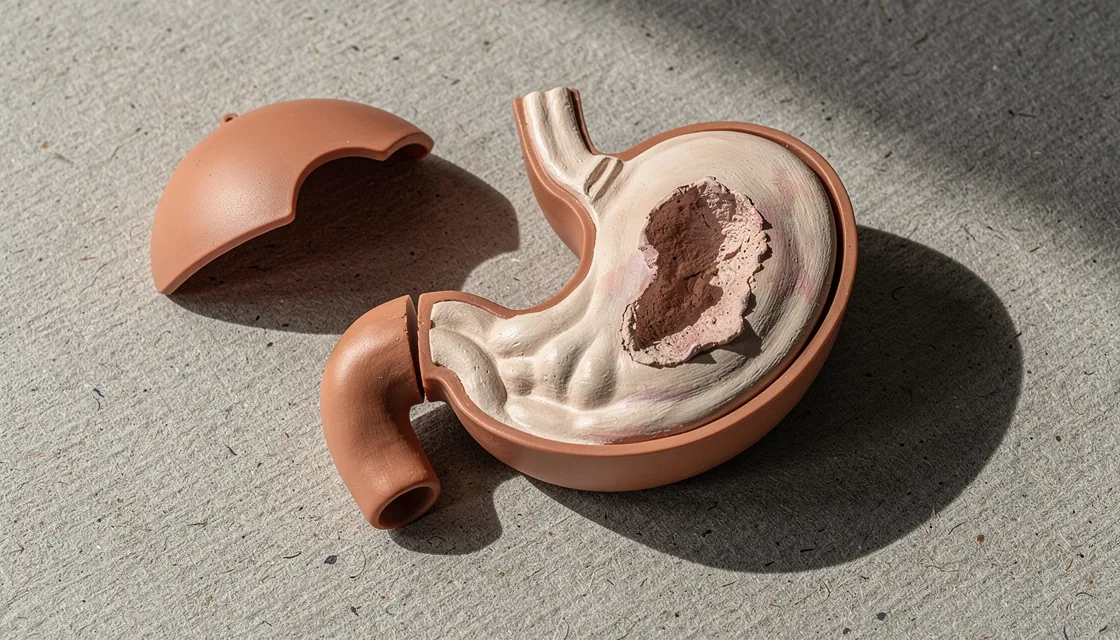
BPC-157 for gastritis
Searches for BPC-157 gastritis often arrive at the ulcer literature. The linked rat ulcer study measures ulcer area, healing and tissue rebuilding. It supplies no controlled clinical result for human gastritis. No rigorous human gut-efficacy trial in the 2025 review closes that gap.
I give gastritis its own entry because borrowing a neighbouring disease's evidence can happen almost unnoticed. The gastric origin provides a reason to investigate the gut; a disease-specific human study would have to answer whether a treatment helps people with that condition. Anecdotal accounts of less bloating, cramping or urgency are described on the reports page, where their limits are explicit.
BPC-157 fistula research
A fistula is an abnormal passage between places that normally stay separate. The 2024 duodenocolic-fistula experiment reported healing of a passage between two bowel regions in rats. The intestinal-anastomosis review concerns the opposite surgical task: healing bowel ends that have deliberately been joined.
That pairing interests me. Closing an unwanted connection and securing a wanted one are distinct repairs, although both sit within the authors' cytoprotection framework. They deserve to retain those separate identities in any account of BPC-157 gut healing.
The 2026 tracheocutaneous-fistula paper extends the fistula question to a passage between a rat's windpipe and skin, linked by the authors to the nitric-oxide system. Its location is outside the gut, and its subjects are still rats. None of these papers establishes treatment of a human fistula.
Oral BPC-157 and capsules
The gastric-stability literature reports that BPC-157 resists breakdown in human gastric juice. That property supports interest in oral administration. Formal human oral pharmacokinetics have not been established: how much intact peptide reaches a person's blood remains unmeasured in a sound study.
Survival in a fluid, entry into blood and clinical improvement are separate measurements. I initially gave gastric stability too much credit; the animal route and uptake results persuaded me to demand each measurement on its own terms. The human reports used the knee, bladder or an intravenous infusion. Controlled trials have established no efficacy for BPC-157 pills.
The earlier bowel-disease programme
An earlier industrial development programme used PL 14736 / PLD-116 and reported safety in early inflammatory-bowel-disease trials. The later review of the clinical record still finds rigorous large controlled efficacy trials lacking.
An early programme is a worthwhile historical lead. It offers no substitute for a published clinical result that can be inspected. For the stomach-ulcer, gastritis and fistula searches that bring readers here, the answer remains tied to the rat experiments and the human studies still needed.