BPC-157 dosage: amounts, routes, species
A study amount arrives with a species, a unit and a route. Removing any of them changes the question.
Rat study amounts
The Achilles-tendon paper used 10 microg, 10 ng or 10 pg per rat in separate groups, using intraperitoneal administration; local administration was also tested. The gastric-ulcer paper used 400 ng/kg and 800 ng/kg in Wistar rats, by intramuscular and intragastric routes.
The units deserve the space they take up. A per-rat amount and a per-kilogram amount express different things. I become suspicious of a dosage claim the moment its units disappear. These figures describe experiments, and simple weight conversion cannot establish a safe or effective human amount.
Animal BPC-157 half-life and uptake
The 2022 pharmacokinetic study followed rats and beagle dogs after intravenous and intramuscular delivery. The elimination half-life was under 30 minutes: that is how long the concentration in blood took to fall by half.
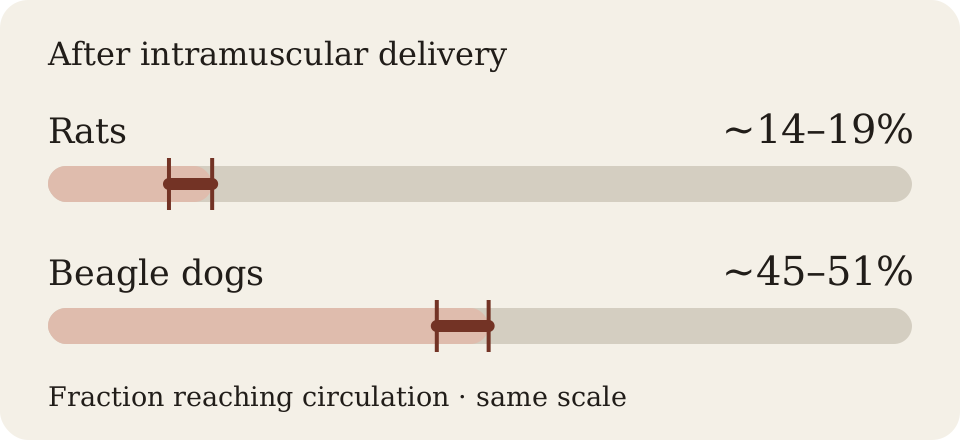
After intramuscular delivery, bioavailability, the fraction reaching the circulation, was approximately 14–19% in rats and 45–51% in dogs. The peptide rapidly broke down into smaller fragments, with excretion through urine and bile. I trust the animal uptake comparison to do more explanatory work than an isolated half-life figure. It shows how much can change before any human conversion is attempted.
Animal blood clearance establishes neither a human therapeutic amount nor an interval for taking it. Formal human oral pharmacokinetics are also unestablished. The capsule question therefore requires more than a statement about gastric stability.
BPC-157 injection routes in the reports
Rodent studies used delivery into the abdominal cavity, muscle, stomach or near an injury, as well as oral administration. The human reports used a knee joint, the bladder or an intravenous infusion. Each route changes the exposure being studied.
The intravenous pilot gave 10 mg, then 20 mg, to two healthy adults. The bladder pilot used a single 10 mg amount during cystoscopy. Those are attributed study amounts, with distinct routes and purposes. Neither report establishes a validated human therapeutic dose.
I refuse to flatten those procedures into one general protocol. The 2025 review still finds rigorous large-scale human trials lacking. There is no approved BPC-157 drug label that supplies a dose, and the research establishes no duration of personal use or preparation and storage protocol for home treatment.